Wait for Event
A wait-until step holds the Automation until a specific event is received.
Unlike a delay, which resumes after a fixed time, this step resumes when something happens in your application.
Common use cases:
- Payment: Wait for a payment to succeed before sending a receipt.
- Adoption: Wait for a user to complete an action to unlock a feature.
- Verification: Wait for the user to verify their email before continuing.
How it works
Section titled “How it works”Add a Wait for event step and configure the event to wait for.
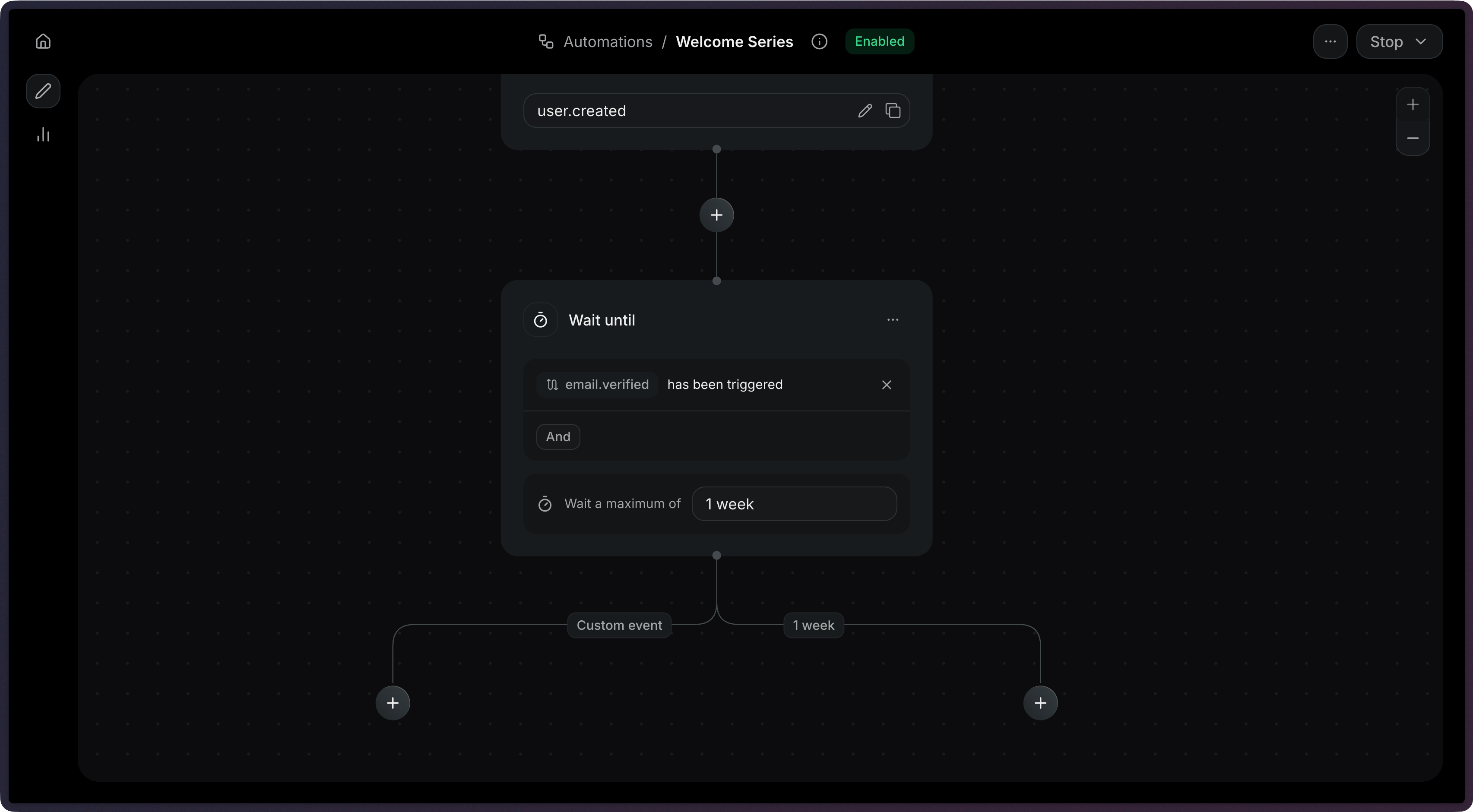
Add a wait_for_event step to your Automation's steps array.
import { Resend } from 'resend';const resend = new Resend('re_xxxxxxxxx');const { data, error } = await resend.automations.create({ name: 'Verification Reminder', steps: [ { key: 'start', type: 'trigger', config: { eventName: 'user.created' }, }, { key: 'verification', type: 'wait_for_event', config: { eventName: 'email.verified', timeout: '1 day', }, }, ], connections: [{ from: 'start', to: 'verification', type: 'default' }],});$resend = Resend::client('re_xxxxxxxxx');$resend->automations->create([ 'name' => 'Verification Reminder', 'steps' => [ [ 'key' => 'start', 'type' => 'trigger', 'config' => ['event_name' => 'user.created'], ], [ 'key' => 'verification', 'type' => 'wait_for_event', 'config' => [ 'event_name' => 'email.verified', 'timeout' => '24 hours', ], ], ], 'connections' => [['from' => 'start', 'to' => 'verification', 'type' => 'default']],]);import resendresend.api_key = "re_xxxxxxxxx"params: resend.Automations.CreateParams = { "name": "Verification Reminder", "steps": [ { "key": "start", "type": "trigger", "config": {"event_name": "user.created"}, }, { "key": "verification", "type": "wait_for_event", "config": { "event_name": "email.verified", "timeout": "24 hours", }, }, ], "connections": [{"from": "start", "to": "verification", "type": "default"}],}resend.Automations.create(params)require "resend"Resend.api_key = "re_xxxxxxxxx"params = { name: "Verification Reminder", steps: [ { key: "start", type: "trigger", config: { event_name: "user.created" }, }, { key: "verification", type: "wait_for_event", config: { event_name: "email.verified", timeout: "24 hours", }, }, ], connections: [{ from: "start", to: "verification", type: "default" }],}Resend::Automations.create(params)package mainimport "github.com/resend/resend-go/v4"func main() { client := resend.NewClient("re_xxxxxxxxx") params := &resend.CreateAutomationRequest{ Name: "Verification Reminder", Steps: []resend.AutomationStep{ { Key: "start", Type: resend.AutomationStepTypeTrigger, Config: map[string]any{ "event_name": "user.created", }, }, { Key: "verification", Type: resend.AutomationStepTypeWaitForEvent, Config: map[string]any{ "event_name": "email.verified", "timeout": "24 hours", }, }, }, Connections: []resend.AutomationConnection{ {From: "start", To: "verification", Type: resend.AutomationConnectionTypeDefault}, }, } client.Automations.Create(params)}use resend_rs::{ types::{ AutomationStatus, Connection, ConnectionType, CreateAutomationOptions, Step, TriggerStepConfig, WaitForEventStepConfig, }, Resend, Result,};#[tokio::main]async fn main() -> Result<()> { let resend = Resend::new("re_xxxxxxxxx"); let opts = CreateAutomationOptions { name: "Verification Reminder".to_owned(), steps: vec![ Step::Trigger { key: "start".to_owned(), config: TriggerStepConfig { event_name: "user.created".to_owned(), }, }, Step::WaitForEvent { key: "verification".to_owned(), config: WaitForEventStepConfig { event_name: "email.verified".to_owned(), timeout: Some("24 hours".to_owned()), filter_rule: None, }, }, ], connections: vec![Connection::new("start", "verification").with_type(ConnectionType::Default)], status: AutomationStatus::Disabled, }; let _automation = resend.automations.create(opts).await?; Ok(())}import com.resend.*;import com.resend.core.exception.ResendException;import com.resend.services.automations.model.AutomationConnection;import com.resend.services.automations.model.AutomationStep;import com.resend.services.automations.model.ConnectionType;import com.resend.services.automations.model.CreateAutomationOptions;import com.resend.services.automations.model.CreateAutomationResponseSuccess;public class Main { public static void main(String[] args) throws ResendException { Resend resend = new Resend("re_xxxxxxxxx"); CreateAutomationOptions options = CreateAutomationOptions.builder() .name("Verification Reminder") .steps( AutomationStep.trigger("start") .eventName("user.created") .build(), AutomationStep.waitForEvent("verification") .eventName("email.verified") .timeout("1 day") .build() ) .connections( AutomationConnection.builder() .from("start") .to("verification") .type(ConnectionType.DEFAULT) .build() ) .build(); CreateAutomationResponseSuccess data = resend.automations().create(options); }}using Resend;using System.Text.Json;IResend resend = ResendClient.Create( "re_xxxxxxxxx" );var startConfig = JsonSerializer.SerializeToElement( new { event_name = "user.created" } );var waitConfig = JsonSerializer.SerializeToElement( new{ event_name = "email.verified", timeout = "1 day",} );var resp = await resend.AutomationCreateAsync( new AutomationCreateData(){ Name = "Verification Reminder", Steps = new List<AutomationStepData> { new AutomationStepData { Ref = "start", Type = "trigger", Config = startConfig }, new AutomationStepData { Ref = "verification", Type = "wait_for_event", Config = waitConfig }, }, Connections = new List<AutomationEdge> { new AutomationEdge { From = "start", To = "verification", EdgeType = "default" }, },} );curl -X POST 'https://api.resend.com/automations' \ -H 'Authorization: Bearer re_xxxxxxxxx' \ -H 'Content-Type: application/json' \ -d '{ "name": "Verification Reminder", "steps": [{ "key": "start", "type": "trigger", "config": { "event_name": "user.created" } }, { "key": "verification", "type": "wait_for_event", "config": { "event_name": "email.verified" } }], "connections": [ { "from": "start", "to": "verification", "type": "default" } ]}'resend automations create --name "Verification Reminder" --file ./automation.jsonTimeouts
Section titled “Timeouts”When you set a timeout, the step will stop waiting after that duration. This prevents Automations from waiting indefinitely.
When a wait-until step times out, it produces two possible connection types:
| Connection type | When it's used |
|---|---|
event_received |
The event arrived before the timeout |
timeout |
The timeout elapsed without receiving the event |
You can create different paths depending on whether the user took action within an given time period.
{ "key": "payment", "type": "wait_for_event", "config": { "event_name": "payment.completed", "timeout": "3 days" }}Filter rules
Section titled “Filter rules”Use filter_rule to match events that meet only specific criteria. This is useful when the same event name might be sent with different payloads.
For example, to wait specifically for a successful payment:
{ "key": "payment", "type": "wait_for_event", "config": { "event_name": "payment.completed", "filter_rule": { "type": "rule", "field": "event.status", "operator": "eq", "value": "succeeded" } }}The filter rule supports the same operators as condition steps.
Configuration
Section titled “Configuration”-
config.event_name(string, required) — The name of the event to wait for. -
config.timeout(string) — The maximum time to wait before timing out (e.g."3 days","1 hour"). Maximum: 30 days. -
config.filter_rule(object) — An optional rule object to filter incoming events.
{
  "key": "wait_for_purchase",
  "type": "wait_for_event",
  "config": {
    "event_name": "purchase.completed",
    "timeout": "3 days"
  }
}